

Neck & shoulder Pain from Desk Work? Watford Injury Clinic Can Help
You spend hours at your desk. By the end of the day, your neck and shoulders feel tight and sore. You notice the pain eases at weekends. But it returns as soon as you sit back at your desk. This pattern of desk strain is common. It does not have to be your normal. Can Watford Injury Clinic help? Yes. Our expert team understands this cycle. We offer targeted treatments to break it. You need early care to prevent recurring pain. You deserve a workday free from pain. Do not let desk strain control your week. Book your appointment today.
Key Takeaways
Fix your forward head posture. It reduces the force on your neck from 60 lbs to 10 lbs.
Seek early treatment at Watford Injury Clinic. They find the root cause of your pain.
Combine manual therapy with home exercises. The clinic provides personalised video guides.
Adjust your desk setup. Follow the 20-8-2 movement rhythm every 30 minutes.
Why Desk Work Causes Neck and upper / lower back Pain
You sit at your desk for hours. Your screen sits slightly too far away. Your shoulders creep upward. This position feels harmless. Yet your body pays a price.
The Role of Posture and Repetitive Strain
Your muscles work hard to hold your head upright. Prolonged seated posture causes muscle fatigue. You begin to slouch. Your head drifts forward. This bent-over posture compresses your neck joints day after day.
The numbers tell a stark story. When you sit poorly, your head projects forward. The weight on your neck can increase from 10 lbs to 60 lbs at a 60° angle. That extra load accelerates wear. Your shoulder girdle also moves forward. This compresses muscles and tendons. Repetitive strain injuries develop.
Certain habits increase your risk. Repetitive activities without rest. Working in awkward positions. Poor posture when sitting. These factors combine. Your overstretched neck muscles lose endurance and strength. When they weaken, other structures compensate. Pain and tightness follow.
One desk worker suffered progressive wrist and shoulder pain. A physiotherapist found poor sitting posture and weak shoulder muscles as the cause. Treatment focused on correcting posture and strengthening the shoulder girdle. The symptoms resolved permanently.
The Weekend Relief Pattern
You notice the pattern yourself. Friday evening arrives. Your shoulders begin to relax. By Saturday, the pain fades. Monday morning comes. You sit back at your desk. Within hours, the tightness returns.
This cycle repeats week after week. Your muscles recover slightly during the weekend. They never fully heal. Each working week adds more strain. The damage accumulates quietly.
You might think the weekend relief means nothing is seriously wrong. Think again. The recurring pattern signals an underlying problem. Without intervention, the tightness becomes chronic.
Early care changes this trajectory. Seeking treatment now prevents recurring tightness. A sports therapist can identify the root causes. You receive targeted treatment. You learn postural corrections. You break the cycle before it becomes permanent.
Do not wait until the pain becomes constant. Your body deserves better. Address the problem now.
Treatments to Relieve Neck, Shoulder and back Strain
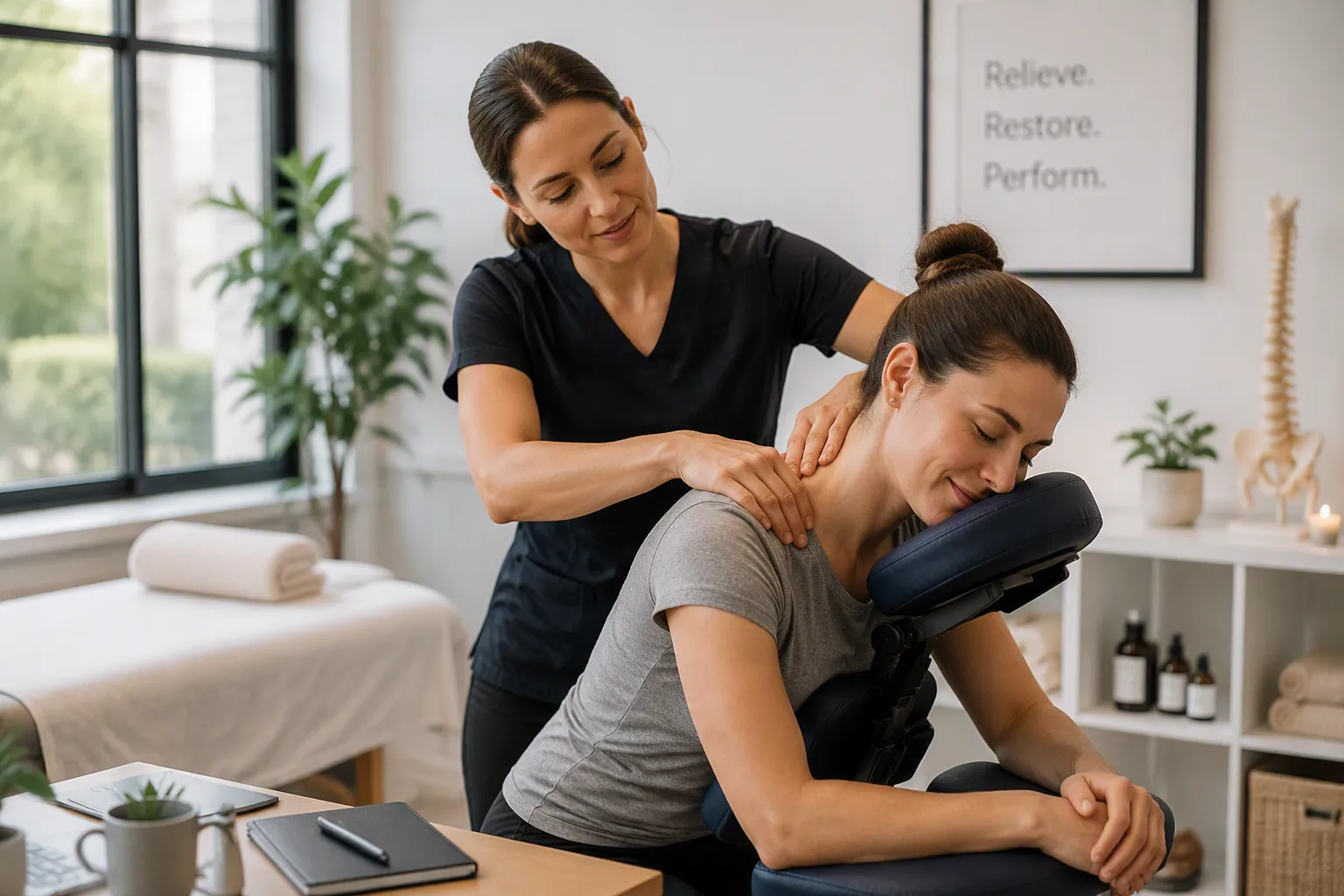
Your desk strain will not vanish on its own. You need targeted treatment that addresses the cause, not just the ache. At Watford Injury Clinic, we treat the whole person. We look beyond your symptoms to find the root of your pain. This holistic approach delivers lasting relief.
Sports Massage and Soft Tissue Techniques
Sports massage forms the backbone of our treatment. We use firm, deep strokes to break down knots and adhesions in your shoulders and upper back. These techniques release tension that builds during long hours at your keyboard. You feel immediate relief as tight muscles begin to soften.
Deep tissue massage targets the deeper layers of muscle tissue. Research shows massage therapy reduces shoulder pain effectively in the short term. One study found that ten sessions of deep tissue massage produced the greatest long-term effect among all treatments tested. Your therapist applies slow, deliberate pressure to reach chronic tension patterns. This work releases stubborn areas that surface massage cannot touch.
Remedial massage takes a clinical approach. Your therapist assesses your posture and movement patterns first. Then they apply specific techniques to correct imbalances. You receive treatment designed for your unique body, not a generic routine.
The benefits extend beyond simple relaxation. Massage improves blood flow to stiff areas. Fresh oxygen reaches your muscles. Metabolic waste drains away. This process counteracts the poor circulation caused by prolonged sitting. Your flexibility improves as muscle fibres lengthen. Your posture corrects itself as overworked muscles release their grip.
A clinical trial demonstrated the power of manual therapy for office workers. Thirty-eight participants received either manual therapy or shoulder stabilisation exercises twice weekly for six weeks. Both groups improved significantly. Manual therapy produced greater gains in pressure pain threshold across multiple muscle groups. Your therapist uses similar soft-tissue and joint mobilisation techniques to achieve these results.
Dry Needling, Cupping and More
Medical acupuncture, also called dry needling, offers another powerful option. Fine needles target specific trigger points in your muscles. Research confirms dry needling reduces pain intensity in the short term. Moderate-quality evidence supports its long-term benefits for pain and disability. The treatment feels minimal. The relief lasts.
Cupping therapy uses suction to lift and stretch tight fascia. Your therapist places cups on your back and shoulders. The gentle pull increases blood flow to the area. Stubborn tension begins to release. Many clients describe the sensation as deeply satisfying.
Percussive therapy uses a handheld device to deliver rapid, targeted pulses. This treatment reaches deep muscle tissue with precision. It works particularly well for larger muscle groups in your upper back. Your therapist combines these modalities to create your personalised plan.
Early intervention makes a crucial difference. A workplace physiotherapy model shows that rapid assessment and treatment prevents recurrence. Workers who receive prompt care experience significant pain reduction. They learn to seek help before symptoms worsen. You can apply this same principle. Book your appointment now. Address your neck strain before it becomes chronic. Your body will thank you.
Your First Appointment at the Clinic
You step into a calm, dedicated two-room studio in Garston, Watford. Mike Minerve founded this clinic in 2010. He brings over twenty years of clinical experience to every session. You receive one-to-one care from the moment you arrive. No waiting rooms packed with other patients. No rushed consultations. Just focused attention on your body and your pain.
Initial Assessment and Root Cause Analysis
Your first session begins with a thorough conversation. You discuss your specific symptoms, your daily work habits, and your treatment goals. Then the physical assessment starts. Mike examines your movement patterns with care and precision.
The assessment covers several key areas:
Mechanical testing of active and passive range of motion in your shoulders and spine
Strength profiling with resisted tests to isolate each rotator cuff tendon
Orthopaedic special tests, including evidence-based provocations like Neer’s and Hawkins-Kennedy tests
Wider chain screening of your cervical spine and thoracic spine to identify stiffness or nerve irritation that may refer pain to your shoulder
Side-by-side comparison of your symptomatic shoulder with your healthy one to reveal subtle differences
This initial consultation lasts between 45 and 60 minutes. You leave with a clear diagnosis. You receive a treatment roadmap and home exercises before you walk out the door. No guesswork. No vague promises. Just clarity about what is wrong and how to fix it.
Immediate Relief and a Personalised Plan
Many patients arrive after months on a waitlist elsewhere. They describe walking away with a single sheet of generic exercises that never helped. Your experience here will differ completely.
Personalised treatment plans tackle pain at its source, with clear actions and milestones. Generic advice offers one-size-fits-all exercises that rarely address the root cause of your discomfort.
Your plan targets the specific imbalances found during your assessment. Hands-on treatment addresses the root cause, not just the site of pain. You receive realistic timeframes for recovery in your first session. Between appointments, you access personalised exercise videos designed for your unique movement patterns.
This approach restores your full performance and confidence. You do not simply manage symptoms. You solve the underlying problem. Your neck and shoulders begin to move freely again. Book your appointment today and experience the difference that expert, personalised care makes.
Long-Term Relief and Preventing Recurrence

Your treatment session ends. Your shoulders feel lighter. The tension that built over months begins to melt away. Yet this relief will not last unless you change the habits that created the problem. Lasting recovery demands your active participation. You need a plan that extends beyond the treatment room.
Strengthening and Stretching at Home
Manual therapy prepares your body for change. Your therapist releases tight muscles and restores mobility. This creates the perfect window for exercise. Clinical evidence confirms that combining hands-on treatment with targeted exercise produces superior long-term outcomes for chronic neck pain compared to single-method care. You improve functional recovery and reduce the likelihood of recurrence.
Your therapist will prescribe specific exercises between appointments. These movements strengthen weak muscles and stretch tight ones. You receive personalised video demonstrations. You practise at home with confidence.
Start with these foundational stretches:
Chin Tucks – Sit up straight, tuck your chin toward your chest, hold for 10–15 seconds, repeat 5–10 times.
Side Neck Stretch – Tilt your head toward one shoulder, hold for 15–20 seconds, repeat 2–3 times per side.
Neck Rotation – Turn your head to one side, hold for 10–15 seconds, repeat 5–10 times per side.
Shoulder Shrugs – Lift your shoulders toward your ears, hold for a few seconds, relax, repeat 10–15 times.
Upper Trapezius Stretch – Tilt your head to one side, gently pull with your hand, hold for 15–20 seconds, repeat 2–3 times per side.
Perform these exercises daily. Consistency matters more than intensity. You retrain your muscles to adopt healthier positions. You build endurance in the deep stabilising muscles of your neck and upper back. Over time, your posture improves naturally.
Manual therapy and soft tissue therapy reduce neck pain effectively but only provide short-term relief. To achieve sustained prevention of recurrence, you must combine these treatments with an individualised exercise programme, education on posture, and lifestyle modifications. You must address the root cause rather than just the symptoms.
Your therapist supports you throughout this journey. You receive guidance between appointments. You can ask questions when exercises feel challenging. You never face this process alone.
Ergonomic Changes for Your Desk
Your home exercise routine builds strength. Yet your desk setup may still sabotage your progress. You spend eight hours daily in your workspace. That environment must support your recovery, not undermine it.
Research demonstrates the power of ergonomic adjustments. One study compared standing desks with traditional seating. The standing desk group experienced significantly lower neck and shoulder discomfort. The traditional desk group developed increased forward head posture and muscle tension. Standing desks allowed alternating postures, reducing sitting time and improving spinal alignment.
Consider these evidence-based adjustments:
Ergonomic Adjustment | Mechanism of Action | Reported Outcome |
|---|---|---|
Chair supporting natural lumbar curve | Restores neutral spine, keeps shoulders relaxed | Lower neck-shoulder discomfort by up to 40% |
Monitor at eye level, arm’s length away | Prevents forward head tilt, reduces cervical disc load | Reduces chronic tension and rotator-cuff irritation risk |
Keyboard and mouse at elbow height | Distributes weight evenly, avoids shoulder rounding | Improves productivity and reduces static muscle load |
Raise your screen and phone to eye level. Roll your shoulders down and back. Maintain a neutral cervical spine. These simple changes prevent forward head posture.
Forward head posture of even a few inches doubles the force on your neck. This increases the load on cervical discs and upper-trapezius muscles. Chronic tension follows. Reduced circulation develops. Your risk of rotator-cuff irritation rises.
Adopt a movement rhythm throughout your day:
For every 30-minute block, work 20 minutes seated to maintain postural stability.
Then stand for 8 minutes to reduce static loading on your neck and shoulders.
Finish with 2 minutes of light movement – stretch, walk, or shift your weight – to restore circulation and prevent muscle fatigue.
These small changes compound over time. Your neck thanks you. Your shoulders relax. Your workday becomes comfortable again. Book your follow-up appointment to track your progress and refine your plan.
You now understand why your desk causes that familiar tightness. You know the treatments available. You see how a personalised plan can break the cycle.
Watford Injury Clinic treats the whole person, not just symptoms. Mike Minerve brings over twenty years of experience to every session. His holistic approach finds the root cause of your discomfort.
Early care prevents recurring pain. You do not need to wait until Monday dread returns. Our convenient Garston location welcomes clients from across Watford and Hertfordshire.
Don’t let desk strain control your week. Book your appointment at Watford Injury Clinic today and take the first step towards lasting relief.
FAQ
How quickly will I feel relief from my neck and shoulder pain?
Most clients notice significant improvement after their first session. Your therapist releases the tightest areas immediately. You leave feeling lighter and more mobile. Full recovery takes several appointments, but you experience meaningful relief from day one. Book your first session and feel the difference yourself.
Do I need to be an athlete or gym-goer to benefit from treatment?
Absolutely not. Office workers form a large part of our client base. Desk strain affects everyone who sits for prolonged periods. Your treatment plan addresses your specific posture and work habits. You receive the same expert care as any athlete. Your pain deserves professional attention regardless of your fitness level.
What should I wear to my appointment?
Wear comfortable, loose-fitting clothing. You need to move freely during your assessment. Your therapist may need access to your neck, shoulders, and upper back. Sports tops or vests work well. Do not worry about changing facilities. Your therapist guides you through positioning during each session.
How many sessions will I need?
Your therapist provides a realistic timeframe during your first appointment. Many clients need between three and six sessions for lasting relief. Some respond faster. Others require ongoing maintenance. Your personalised plan adapts as you progress. You receive clear guidance about what to expect from the very beginning.