Most common causes of quadriceps muscles pain and when to seek help
Most common causes of quadriceps muscles pain and when to seek help
You are halfway through a run, mid-squat, or stepping out of bed the morning after a hard session, and there it is: a sharp, nagging ache at the front of your thigh, classic quadriceps muscles pain. Most people call it a sore quad and carry on. That decision, made a dozen times over several weeks, is exactly why clinicians commonly see patients whose minor anterior thigh pain was left unchecked and later required considerably longer rehabilitation.
Anterior thigh pain is not one condition. It is a category, and the cause changes everything: how you manage it today, how long recovery takes, and what you should absolutely not be doing. A muscle strain needs a different approach to tendinopathy. A contusion is managed differently to referred pain from the lumbar spine. Getting that distinction right from the start saves you weeks.
This article walks through the main causes of quadriceps muscles pain, what the symptoms tell you, how to manage the first 72 hours, how rehabilitation is structured, and when you need professional eyes on the problem rather than another week of hoping it settles.
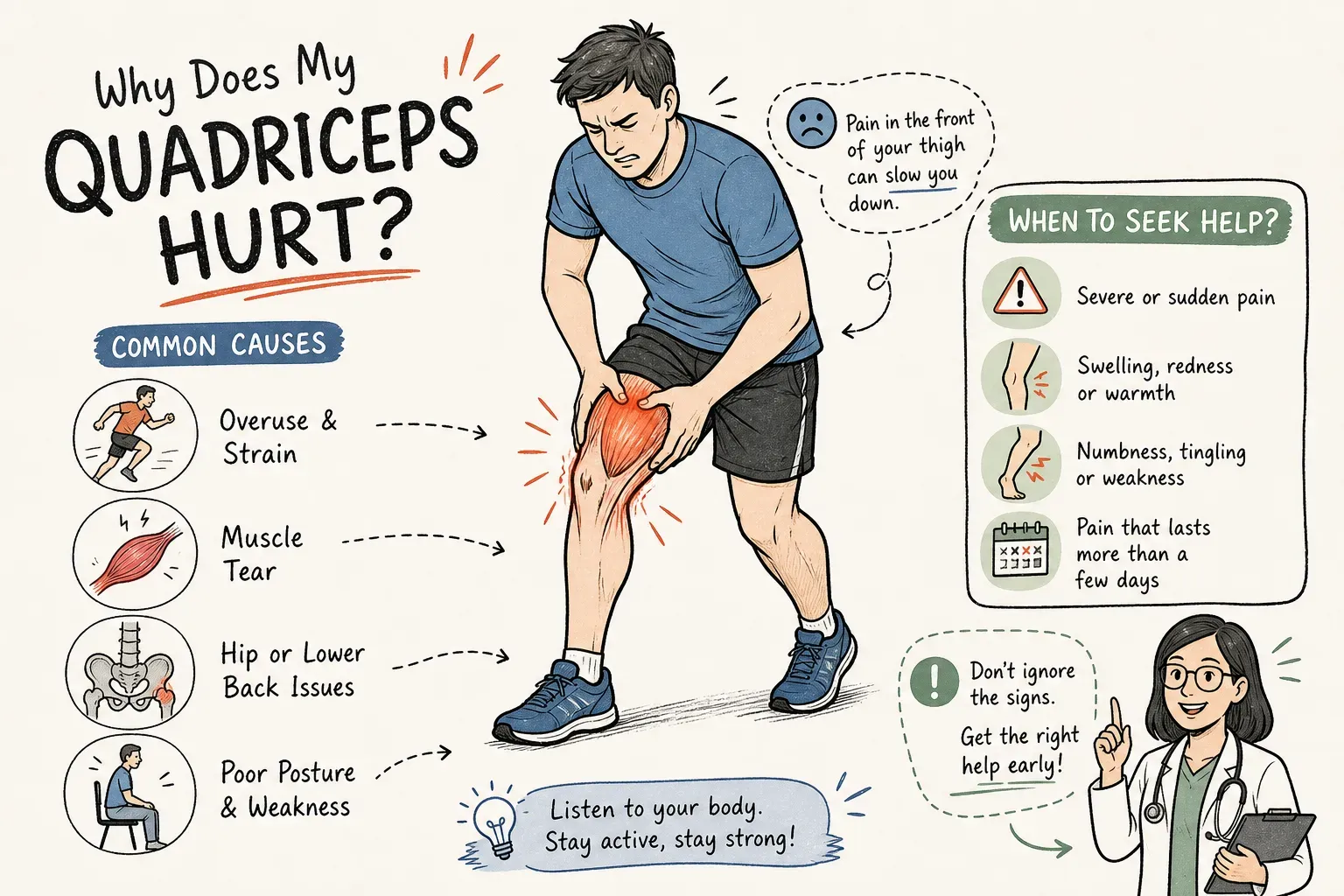
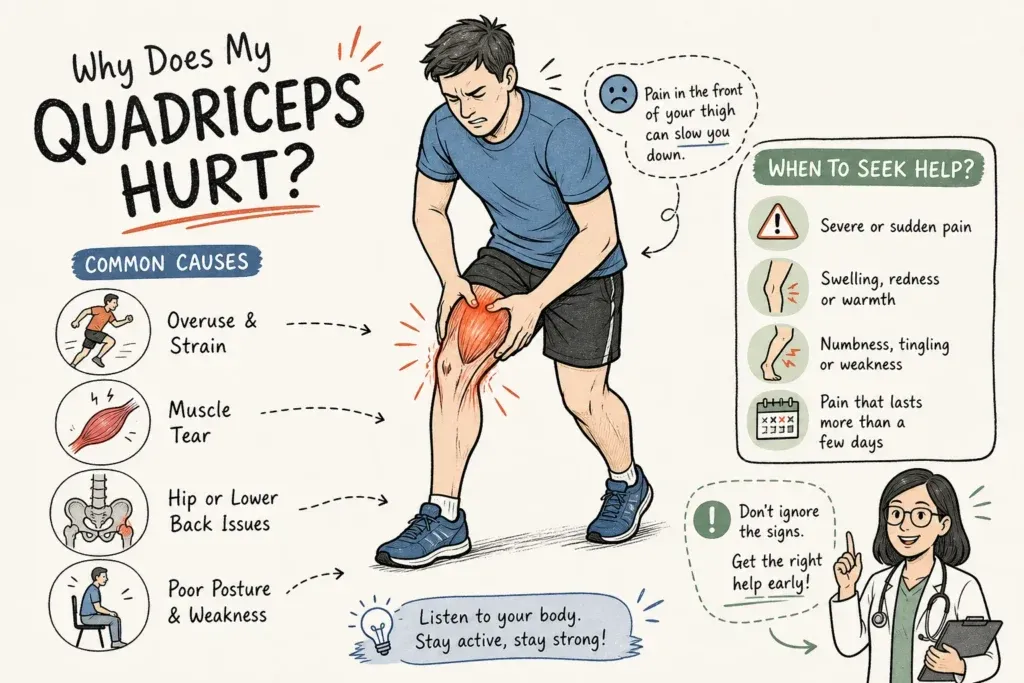
Causes of quadriceps muscles pain: what is actually happening
Muscle strains and partial tears
A quadriceps strain happens fast. One sprint, one kick, one jump where the muscle is asked to produce more force than it can manage, and fibres overstretch or tear. The severity is graded from one to three, and that grade shapes everything that follows.
Grade 1 feels like a sharp twinge with minimal strength loss. You can probably walk away from it, but sprinting or forceful contraction hurts. Grade 2 involves more significant fibre disruption: noticeable pain, measurable weakness, swelling that develops over hours, and sometimes a small palpable defect in the muscle. Grade 3 is a severe or complete tear with major functional loss, marked bruising, and an inability to extend the knee effectively. That one does not sort itself out with rest.
The rectus femoris is the most commonly strained of the four quadriceps heads, particularly at the proximal tendon where it attaches near the hip. Injuries here tend to take longer to heal than strains elsewhere in the quad group, so a “mild” proximal rectus femoris strain can still sideline a runner or footballer for five to eight weeks if managed poorly.
Overuse and tendinopathy
Quadriceps tendinopathy does not arrive with a single bad moment. It builds gradually from repetitive loading, particularly when training volume ramps up faster than the tendon can adapt. The resulting quad pain sits just above the kneecap and tends to be a dull ache rather than a sharp one: worse on stairs, after prolonged sitting, during squats, or the morning after a heavy session.
Runners, cyclists, and gym-goers who increase their mileage or training load too quickly are the most common presentations. The insidious nature of tendinopathy is the problem: it starts mild enough to ignore, and the window between “manageable” and “persistent and limiting” closes faster than most people expect. Tendons respond to progressive load, not rest, so doing nothing makes it worse over time.
Contusions and referred pain
A direct blow to the thigh, common in rugby, football, and martial arts, creates a contusion. Deep tenderness, restricted knee bend, and bruising that appears hours later are typical. Most contusions resolve without complication, but severe ones carry a risk of myositis ossificans, where calcium deposits form within the muscle as it heals. Early aggressive massage or stretching in the first few days may increase that risk, as it can aggravate bleeding within the muscle; the evidence base is largely case-series data, but the caution is well established in clinical guidance.
Referred pain deserves its own mention because it is frequently missed. The lumbar spine, hip joint, and sacroiliac region can all produce anterior thigh pain that feels as though it originates in the quad itself. Distinguishing features include no clear injury event, poorly localised pain, possible tingling or numbness alongside it, and symptoms that behave differently depending on posture or movement of the back and hip rather than the thigh itself. Treating the wrong structure wastes time.
Symptoms that signal something is wrong, and red flags you cannot ignore
A strained quad produces focal tenderness, pain when the thigh is stretched, and weakness during knee extension. Swelling and bruising may take a few hours to fully develop, so a muscle that feels “not that bad” immediately after injury can look and feel considerably worse by the following morning.
Tendinopathy presents as a dull ache that often eases during a warm-up, only to return after activity or the next morning. Contusions produce deep, localised soreness and restricted knee flexion. These are manageable with appropriate self-care. However, if symptoms are not improving within a few days, or if any of the following are present, do not wait.
The following are not manageable with self-care. Seek assessment the same day if you experience any of these:
- Inability to straighten the knee or bear weight through the leg
- A visible gap, deformity, or obvious contour change in the thigh
- Rapidly increasing swelling that makes the muscle feel hard or “wooden”
- Pain severely out of proportion to the injury, particularly pain that escalates despite rest
- Numbness, tingling, or new weakness in the leg
- A sudden “pop” followed by immediate bruising and complete loss of quad function
The rapidly swelling, firm thigh with escalating pain warrants particular attention. Rising pressure within the thigh compartment can compromise circulation and nerve function, a condition called compartment syndrome. A normal pulse in the foot does not rule it out; paralysis and pallor are late signs, not early ones. This is an emergency, not a wait-and-see situation.
Managing quadriceps muscles pain in the first 48 to 72 hours
The PEACE framework for acute quad pain
PEACE, Protect, Elevate, Avoid anti-inflammatories where possible, Compress, and Educate, is a currently recommended, evidence-informed mnemonic widely used to guide early soft-tissue injury management. It reflects a more nuanced understanding of tissue repair than the older RICE approach, though individual components should be applied based on clinical presentation.
Protect means stopping painful loading immediately. If walking causes a limp, use crutches temporarily rather than grinning through it. Avoid aggressive stretching, heat, and massage in the first 24 to 48 hours, as all three may worsen bleeding and swelling within the muscle. Elevate the leg above hip height when resting to limit fluid accumulation.
A light compression sleeve or wrap can help if swelling is present, but it should not cause tingling or numbness below the wrap; if it does, it is too tight. The caution around anti-inflammatory medication is based on evidence that inflammation plays a functional role in tissue repair. NSAIDs are not automatically harmful, but they are not the first-line default either. Discuss with a pharmacist or clinician, particularly if you have existing health conditions.
Moving into the LOVE phase
LOVE stands for Load, Optimism, Vascularisation, and Exercise. After the first one to three days, this phase shifts the focus from protection to active recovery. Load means symptom-guided progression: not pushing through sharp pain, but not lying still for a week either. Start with pain-limited walking and basic quadriceps activation, and progress from there.
Ice provides short-term comfort rather than tissue healing. Apply it for 10 to 20 minutes through a cloth, with rest intervals between applications. Paracetamol is a reasonable first-line pain reliever when safe for the individual. If short-term NSAID use is appropriate for you, a pharmacist can confirm interactions and contraindications before you start.
Rehabilitation: staged exercises and realistic recovery timelines
Early activation to strength restoration
Phase one covers roughly the first week for grade 1 strains, and longer for grades 2 and 3. The focus is basic quadriceps activation: quadriceps sets (tightening the thigh while the leg is straight), isometric holds, straight-leg raises, gentle heel slides, and easy cycling once walking is comfortable. The aim is to maintain neuromuscular connection to the muscle and prevent excessive deconditioning without disrupting healing tissue.
Phase two, typically weeks one to four, introduces short-arc knee extensions, bridges, mini-squats, leg press, and step-ups. Progress load only when previous exercises are pain-free and produce no increase in symptoms the following morning. That next-day response is your most reliable guide to whether you have done too much.
For tendinopathy specifically, slow-tempo loading is the priority. Wall sits, slow squats, split squats, and isometric holds of 30 to 45 seconds work well to reduce pain while building tendon capacity. Rather than chasing range of motion early, focus on controlled load through whatever range is currently comfortable.
Advanced loading and return to activity
Phase three, from around weeks three to eight for strains and weeks six to twelve for tendinopathy, introduces single-leg squats, step-downs, eccentric work, and sport-specific drills including acceleration and change of direction. This is the phase most people rush, and it is where re-injury rates are highest.
On timelines: grade 1 strains often resolve in one to three weeks; grade 2 takes three to six weeks; grade 3 injuries commonly require eight to twelve weeks or considerably longer; established tendinopathy often needs eight to twelve weeks of consistent loading, and sometimes three to six months for longstanding cases. These are averages, not guarantees.
Return-to-sport decisions should be based on criteria, not calendars. Full pain-free range of motion, near-symmetrical strength compared to the other leg, no pain during sprinting or kicking, and successful hopping and running tests matter more than how many days have passed.
When self-care is not enough: how professional treatment helps
What a specialist assessment looks like at Watford Injury Clinic
At Watford Injury Clinic, every presentation of thigh pain begins with a thorough clinical assessment: movement screening, strength testing, palpation to identify the exact structure involved, and a detailed history that distinguishes a true quadriceps injury from referred pain originating elsewhere. That distinction is not academic, it directly determines what treatment is appropriate.
Treating tendinopathy with the same approach as an acute muscle strain slows recovery rather than accelerating it. Many clients arriving from across Watford and St Albans have spent weeks applying generic advice without clear progress. A specific diagnosis changes the treatment plan entirely, and that clarity is usually the turning point in recovery.
Hands-on treatment options
Sports massage and deep tissue massage can reduce muscle tension and address compensatory tightness in surrounding structures such as the hip flexors and iliotibial band. Evidence that massage increases local circulation or speeds structural healing is mixed, but its value in reducing pain, muscle guarding, and short-term mobility restrictions is well supported. These surrounding structures often tighten in response to an injured quad, and ignoring them can prolong the overall recovery timeline.
Dry needling targets trigger points within the quadriceps that contribute to persistent pain and weakness, particularly after a contusion or with chronic overuse patterns. Fine needles are used to disrupt sustained muscle contraction within the trigger point and activate the nervous system’s own pain-inhibition pathways. Research supports short-term benefit as an adjunct to rehabilitation, though long-term evidence remains limited. It works alongside structured exercise, not as a standalone fix.
Sports therapy at the clinic combines manual treatment with a structured rehabilitation programme tailored to the individual’s goals, whether that is returning to weekend football, managing a physically demanding job, or simply walking the stairs without pain. Treatment does not stop at the table. Clients leave each session with clear, graded exercises and a progression plan they can follow independently.
Getting the right help at the right time
Quadriceps muscles pain has identifiable causes, and getting the right one matters. A mild grade 1 strain managed correctly in the first few days often resolves within two weeks. The same injury pushed through for four weeks because it felt manageable can develop compensatory movement patterns that extend recovery significantly, continuing to load an acutely irritated muscle without appropriate guidance tends to delay recovery and increase functional impairment. Early, appropriate management often shortens downtime considerably.
Self-care works for mild presentations when applied correctly. But red flags, persistent quad pain without clear progress, and presentations where the cause is unclear all need professional assessment. Early, accurate diagnosis saves weeks of unnecessary downtime, and that saving compounds: less time injured means more consistent training, better long-term performance, and a lower risk of re-injury.
If you are in or around Watford or St Albans and quadriceps muscles pain has been limiting you for more than a few days without clear improvement, get in touch with the team at Watford Injury Clinic. Book an assessment, get a clear diagnosis, and get moving again.